On impermanence, ritual and the quiet erosion of a world.
The Makioka Sisters by Junichiro Tanizaki was my final reading of 2025, a book I read during the quiet time of the Christmas holidays. At nearly 900 pages, the novel initially feels imposing. And yet, once immersed in it, you cannot help but be captivated.
This was my first encounter with Tanizaki’s writing, and it left a strong impression.
In this piece, I want to share a few characteristics of the novel that stayed with me during and after the reading.
A novel without urgency and without plot
Set in Japan during the 1930s and early 1940s, The Makioka Sisters follows the lives of four sisters from a once-prosperous merchant family. Their youth was marked by wealth, status, and, at least for the three eldest, a strictly traditional education. As the novel unfolds, however, their world begins to shift.
There is no dramatic plot, no decisive turning point, no heroic arc. Instead, the novel lingers on the sisters’ everyday concerns: family obligations, reputation, social appearances, and above all, the search for suitable husbands for the two younger sisters.
War, political instability, and the rapid modernization of Japan remain largely in the background, still present, but never highlighted. These transformations seep into the story quietly, through small disruptions: changes in neighborhoods, letters from former European neighbors writing in passing about the war, and casual remarks or comparisons with the past that indirectly mark how much things have changed.
Impermanence
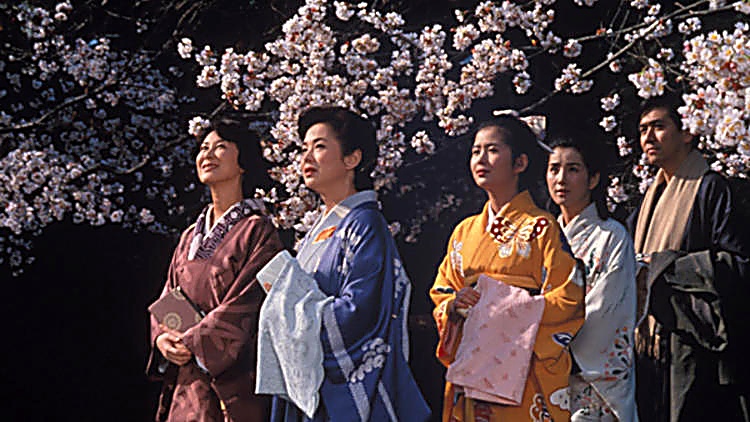
One of the most powerful aspects of the novel is its deep engagement with impermanence. Time passes not through events, but through cycles: the changing seasons, repeated rituals, annual family trips, most notably to Kyoto to admire the cherry blossoms in bloom.
Nothing is static, yet nothing is rushed.
This absence of a conventional plot reinforces the sensation that life is simply unfolding, regardless of whether the characters fully grasp what is happening around them. The sisters seem almost oblivious to the magnitude of the historical moment they inhabit. Their concerns rarely extend beyond their immediate sphere, and there is something both unsettling and deeply human in this inward focus.
Tanizaki shows how a society can be transforming radically while its individuals remain absorbed in what appears, from the outside, to be trivial.
The importance of sisterhood
Despite their differences, and sometimes because of them, the bond between the sisters remains central. Their relationships are complex, occasionally strained, but always marked by a deep sense of responsibility toward one another. Each sister, in her own way, carries the others with her.
This focus on sisterhood gives the novel its emotional magnitude. Even in moments where very little “happens,” the reader feels compelled to continue, turning page after page to see whether the next suitor will be the right one, how a relationship may evolve, or how the family equilibrium will adjust once again.
A quiet masterpiece
The Makioka Sisters is not a novel of action, but of attention. It asks the reader to slow down, to observe, and to accept that meaning often lies not in dramatic events, but in the unfolding of everyday life.
It is also a reminder that historical change is not always experienced as such by those living through it. Sometimes, history happens quietly while people are busy living their lives.
In the end, sisters remain sisters, cherry blossoms return every spring and time keeps moving forward, whether we notice it or not.
The novel was adapted into a film in 1983 by Kon Ichikawa, which I have yet to see.
Reading The Makioka Sisters feels less like finishing a story than like leaving a place.
 The Kitsune Journal
Leave a comment